


Tube feeding with a gastrostomy tube — Canterbury
A gastrostomy is an artificial opening (stoma) through your tummy (abdomen) into your stomach. It lets you take your feed, fluids and medications directly into your stomach. This page tells you how to care for your feeding tube and stoma.
On this page
- What a gastrostomy is
- PEG feeding tube
- RIG feeding tube
- Caring for your stoma and feeding tube
- How to feed using the tube
- Caring for your equipment and feed
- How to take medications through your tube
- Troubleshooting tube feeding problems
- Getting supplies of ENFit syringes and pump giving sets
- Enteral feeding contact details
What a gastrostomy is
A gastrostomy is an artificial opening through your abdomen into your stomach. A feeding tube is inserted through the opening so that special liquid food (feed), medications and fluids can go directly into your stomach. Some feeding tubes go down into your jejunum, a part of your small intestine (small bowel) below your stomach.
There are 2 types of gastrostomy tube:
- PEG (percutaneous endoscopic gastrostomy)
- RIG (radiologically inserted gastrostomy).
PEG and RIG are terms that describe how the tube is fitted. PEG and RIG tubes both have centimetre (cm) markings.
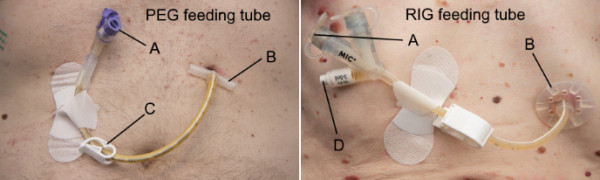
A gastrostomy PEG feeding tube and a RIG feeding tube. A, feeding port. B, flange (bumper). C, clamp. D, balloon inflation-deflation port.
PEG feeding tube
The PEG tube has a flange (bumper) inside your stomach to keep your tube in the right position. The tube can stay in place for 18 months or longer.
After an initial healing period, the original PEG tube can be changed to a smaller low-profile PEG device. It is used with an extension set that is needed to access the feeding port.
RIG feeding tube
The RIG tube has a water-filled balloon that holds the tube in your stomach. The nurse will show you how to check and top up the balloon.
If the flange (bumper) is at the same (cm) marking but further away from your skin than normal, the balloon may have deflated. If this happens, top it up as needed.
The tube needs to be replaced approximately every 6 months. This is a very simple procedure, and the Enteral Feeding Service will contact you to arrange a clinic appointment.
Caring for your stoma and feeding tube
Your stoma
- For the first 1 to 2 days after your tube is inserted, you can expect a small amount of discharge from your stoma. This will get less as it heals.
- For the first 10 to 14 days, clean your stoma at least once a day using the saline solution provided by the Enteral Feeding Service.
- After 14 days, you can clean your stoma daily with warm soapy water.
- Always dry under the tube flange to minimise moisture against your skin.
- For the first 10 to 14 days, you can apply an antimicrobial dressing to your stoma. A dressing is not needed long term.
- After 6 weeks you can swim or have a bath, or when advised by your surgeon. You can shower after 24 hours.
Your feeding tube
Important — if your feeding tube comes out, your stoma will begin to close within 2 to 3 hours. Contact the Enteral Feeding Service immediately. You may need to go to the hospital to have it put back in.
- Starting the day after having your feeding tube inserted, turn the tube 360 degrees daily. This stops the tube from sticking.
- 7 days after insertion, start moving the tube slightly in and out of your stoma daily. This stops the tube from sticking.
- 14 days after insertion of a RIG, the sutures (T-fasteners) around your tube can be removed. Sometimes they will have already fallen off. If they are still in place, see your practice nurse or the Enteral Feeding Service to have them removed.
- Attach your feeding tube to your stomach using the tube Grip-Lok securement device supplied by the Enteral Feeding Service. This will stop it moving too much in your stoma.
- If you gain or lose weight, reposition the flange (bumper) on the tube by sliding it up or down the feeding tube. It should sit no more than 5 mm away from your skin surface.
- Before starting your feed, always check that the flange (bumper) is in the same position.
- If you are not using your feeding tube for feeding, flush it with warm water at least twice a day.
- If you have a RIG, you or your carer must routinely check the balloon volume from 1 month after having your tube inserted, and top it up as needed. Do this every 1 or 2 weeks.
- If you have a PEG, you will be taught to replace the feeding port if it gets damaged. Contact the Enteral Feeding Service for guidance on this if needed.
How to feed using the tube
Flush your feeding tube with warm water before and after you tube feed. Also flush it before and after you take medications down your tube.
If you have safe drinking water, you can use tap water to flush your tube. Otherwise, use boiled, cooled water.
If you have a jejunal tube, always use boiled, cooled water to flush your tube.
Feeding methods
There are 3 methods of tube feeding:
- gravity feeding
- bolus feeding
- pump feeding.
Your dietitian will decide which type of feeding is best for you.
Gravity feeding
This is where the feed flows out of a syringe or feed bottle and into the feeding tube by gravity.
Bolus feeding through a syringe
This is when you have a set amount of feed at specified times during the day. This is like having meals at mealtimes.
Pump feeding
This is when a pump is used to continuously deliver a set amount of feed through your feeding tube over a set amount of time.
Your dietitian will discuss the options with you in more detail and provide you with a feeding plan and instructions when needed.
Bolus or gravity feeding plan — Health New Zealand Canterbury [PDF]
Pump feeding plan — Health New Zealand Canterbury [PDF]
Caring for your equipment and feed
- After feeding, wash the syringe with mild dishwashing detergent, rinse thoroughly and leave it to air dry.
- Place the syringe in a clean zip-lock bag or a clean container with a lid. Store it in the fridge to prevent it being contaminated by bacteria.
- You can use each syringe for about 2 weeks.
- Giving sets (only used for pump feeding) can only be used once. Throw them away after you have used them for 24 hours and do not reuse them.
- Cover open cans or bottles of feed and store them in the fridge. Throw away any open, unused feed after 24 hours.
- You can use open ready-to-hang bottles of feed for 24 hours. Throw away any open, unused feed after 24 hours.
- Your feed should be at room temperature when you use it. If it has been in the fridge, leave it for 30 minutes before using it.
How to take medications through your tube
The hospital pharmacist will review your medications before you go home. They will make sure you can take your medications through your feeding tube. There are some important points to note.
- Use the main port of your feeding tube for medications.
- Use the bolus feeding method (see above) to put medications down your feeding tube unless your dietitian or nurse tells you to do it another way.
- Flush your tube with 20 ml warm water before and after giving medications. This helps to prevent your feeding tube from blocking.
- If you have more than 1 medication, take each one separately. Flush your feeding tube with 10 ml to 15 ml of warm water between each medication.
- Finely crush each solid medication separately (a mortar and pestle is best for this). Mix it with 10 ml to 15 ml of water before putting it down the feeding tube.
- You can take liquid medications down your feeding tube without diluting them.
Troubleshooting tube feeding problems
Possible cause
You may have an infection. First check that the flange is not too firm on your skin.
Recommended action
See your healthcare provider, who may prescribe antibiotics. If you have a fever, chills and tiredness, see your healthcare provider, as soon as you can. If it is after hours, go to an after-hours clinic or emergency department.
Your skin is raw with raised red or pink tissue around the tube insertion site. You may also notice increased fluid or discomfort around the area.
Possible cause
You may have what is called overgranulation tissue.
Recommended action
This is common and easily treated. Contact the Enteral Feeding Service within normal working hours.
Recommended action
Try to unblock it using a 60 ml syringe half filled with warm water. Use a gentle push and pull method to clear the blockage.
If you cannot clear the blockage, contact the Enteral Feeding Service.
If you need your tube to stay hydrated and to take essential medications, contact the on-call service if the blockage occurs after hours.
Possible cause
Your tube may have come out of your stomach but is still sitting under your skin.
Recommended action
Contact the Enteral Feeding Service. If after hours, contact the on-call service.
Getting supplies of ENFit syringes and pump giving sets
Contact the Health New Zealand Supply Department for Canterbury (see below).
Give as much notice as possible. Let them know if you cannot collect the giving sets as they can courier them to you. There is no charge for giving sets, syringes or delivery.
If you are under the care of the Ashburton Hospital dietitians, phone the Ashburton Supply Department (see below). You will need to collect your giving sets from the Supply Department.
Your hospital dietitian will organise your feed when you first go home. After this, your community dietitian will organise it. If you need to contact your feed supplier because your feed has not arrived, use the contact details below.
Other tube-related supplies
Items supplied directly from the Enteral Feeding Service include:
- extensions for low profile devices
- Grip-Lok securement devices
- replacement PEG ports
- dressings
- drainage bags
- balloon checking equipment (syringes and sterile water).
The Enteral Feeding Service will work out with you which supplies you need. You will be given the supplies when your tube is first inserted, and more supplies will be sent to your home every 2 months. If you find you are receiving more or less than you need or you need any urgent supplies, contact the service:
Enteral feeding contact details
Enteral Feeding Service
To contact the Enteral Feeding Service:
- phone: 027 351 2474 or 03 364 0640 (extension 88945)
- email: gastro.pegnurse@cdhb.health.nz
Our hours are Monday to Friday, 7:30am to 4:30pm.
For urgent help after hours (only after hours), for example, if your tube falls out, phone Christchurch Hospital and ask to speak with the gastroenterology nurse on call.
- Christchurch Hospital, phone: 03 364 0640
Health New Zealand Supply Department
To contact the Health New Zealand Supply Department for Canterbury:
- phone: 03 364 0082 or 03 364 0080
- address: 4 Rapide Way, Yaldhurst, Christchurch (near the airport).
Our hours are Monday to Friday, 7:30am to 4:30pm.
Ashburton Hospital Supply Department
To contact the Ashburton Hospital Supply Department:
- phone: 03 307 8462
- address: Ashburton Hospital, Entrance D, 12 Elizabeth St, Ashburton.
Open for collection Monday to Friday, 10:30am to 2:30pm.
Feeding pump suppliers
For any issues with your pump, use the following contact details:
FreeGo pump — Abbott Nutritionexternal link
- phone: 0800 738 090
Nutricia Flocare Infinity Pump II — Nutriciaexternal link
- phone: 0800 222 430
Kangaroo Joey pump — Cardinal Healthexternal link
- phone: 0800 522 400
Feed suppliers
Abbott and Nestle feed (through Unichem Ilam Healthworks Pharmacy)
- phone: 03 351 8633
Nutricia feed
- phone: 0800 688 747